


What To Consider When Buying Cornhole Bags
Your cornhole bags can either enhance your game, or take away from your enjoyment. Choosing the right bags can have the same effect as choosing the right golf ball, basketball shoe, or tennis racket. Let's explore the differences between bags and things to consider when you purchase a set.
What's inside your bags?
A bags fill makes a difference. See the pros and cons of every option

dual speed vs. single speed

Bags come in a single speed option (they have the same fabric on both sides) or a dual speed option (a different fabric on each side). Single speed bags (typically duck cloth or canvas) are easy to throw and play consistently if you're a novice and are preferred by people who cannot throw a "flat" bag. Dual speed bags are preferred in almost every cornhole tournament. One side is usually a "slower" side which keeps the bag on the board. The other side is "faster" which helps you push bags, or overcome a slow set of boards. More experienced players can use dual sided bags to "roll" a bag over an obstacle, or jump a bag, or in some instances curve it towards the hole.
Ryan Bishop throwing a flat bag using a set of FanBags Koda's
speed ratings
what is a speed rating and how does it impact my bags?
Speed ratings tell you how fast or slow a particular side of your bag is. Every rating is done on a scale of 1 through 10. 1 is the slowest (usually a suede material) and 10 is the fastest. When you throw a bag with a 1, it will slow down dramatically and keep your bag on the board. But the drawback is that it'll be impossible to push or move closer to the hole. A bag with a 10 will not slow down at all so your ability to aim is crucial. But you can push it all over the board and closer to the hole. Most pro's play with super fast bags, amateurs tend to use a balanced bag with one fast side and one slow side, and those new to the game will like a "stick and slick" bag with a really slow side and one medium side.


Koda Series Bag showing its Medium 5 speed side.


Duck cloth bags

A set of red and blue duck cloth, corn filled, cornhole bags.
Duck cloth bags are incredibly common at most bars, restaurants, or places that offer cornhole to the general public. They're cheap and the cloth itself is very strong and rigid. The drawback to duck cloth is that the fabric is so strong and rigid. Duck cloth bags tend to "clog" the hole because they keep their shape. They also tend to fly right over the hole instead of grabbing it and going in. A less rigid fabric will start to fall into the hole or "drip" where a duck cloth bag will just sit and needs a majority of its mass to get it to fall into the hole.

stick and slick bags

The suede (stick) side of a FanBags 4Bagger Stick and Slick bag.

Stick and slick bags are perfect for those people getting started with the game of cornhole, and casual players. The suede (Stick) side will slow your bag down on the board and in most cases keep your bag on the board. This is great for people who constantly cannot keep a bag on the board. A stick side can also give you a competitive advantage by being able to throw a BLOCKER. This is a bag that sits in front of the hole so your opponent cannot slide their bag into the hole. The slick side is great for people who can consistently aim and place their either short of the hole or slide their bag up the board and into the hole. A slick side can also push other bags out of the way or push your bags closer or into the hole. The only drawback to Stick and Slick bags is that the suede side is hard to push. So if you need to push your own bag into the hole, it will be harder with the suede side down.
The canvas (slick) side of a FanBags 4Bagger Stick and Slick bag.

carpet bags

A close up of the carpet side of a set of SABRE cornhole bags by FanBags Cornhole.

A set of SABRE carpet cornhole bags in orange and black with a grey carpet back

A set of SABRE carpet cornhole bags in red and black with a grey carpet back
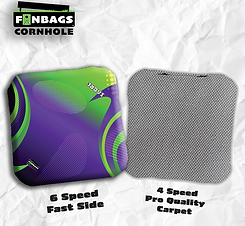
Why Choose Carpet Cornhole Bags?
Carpet cornhole bags have become one of the most popular options in competitive and serious backyard play—and for good reason. They’re all about control, versatility, and forgiveness, especially when conditions or opponents get tricky.
Carpet bags feature a professional-grade carpet fabric on one side and typically a faster material on the other. This creates a dual-speed bag, giving players more shot options compared to traditional slick or suede-style bags.
Pros of Carpet Cornhole Bags
Superior Bag Control
Essentially, carpet slows the bag down, making it easier to stick the landing, avoid blowing past the hole, adjust speed on fast boards. This is huge for newer players and deadly for experienced ones since you can move the bag easier than a suede bag.
Perfect for Blocking Shots
Need to shut down a hot opponent? Carpet bags excel at dropping blockers, forcing opponents to go around of over you, playing all around DEFENSE
Ideal for Roll & Cut Shots
Carpet grabs the board just enough to roll into the hole, cut around a blocker bag, drip into the hole when they're close.
If finesse shots are part of your game, carpet bags are your best friend.
Cons of Carpet Cornhole Bags
Less Slide for Power Players
If your game relies on hard, fast throws, straight push shots, carpet bags may feel "too slow" on certain shots.
Requires More Precision on Long Pushes
Carpet won’t glide as easily through traffic, so pushing multiple bags into the hole can take more effort and accuracy.
Slight Learning Curve
Players used to all-slick bags may need a few games to adjust throw speed, and ultimately learn when to use each side
Once dialed in, most never go back.
A set of SABRE carpet cornhole bags in purple and green with a grey carpet back
